
When planning a solar project, one of the most important early-stage questions is: how much does the mounting system cost per MW?
While module prices often get the most attention, the mounting structure can significantly impact overall CAPEX, installation efficiency, and long-term reliability. In this article, we break down typical solar mounting system costs per watt (USD/W) across different installation types, and explain what factors actually influence the final pricing.
1. Typical Solar Mounting System Cost per Watt
Below are industry reference prices based on common project conditions. These are baseline FOB-level engineering cost ranges, and should be used as a starting point for budgeting:
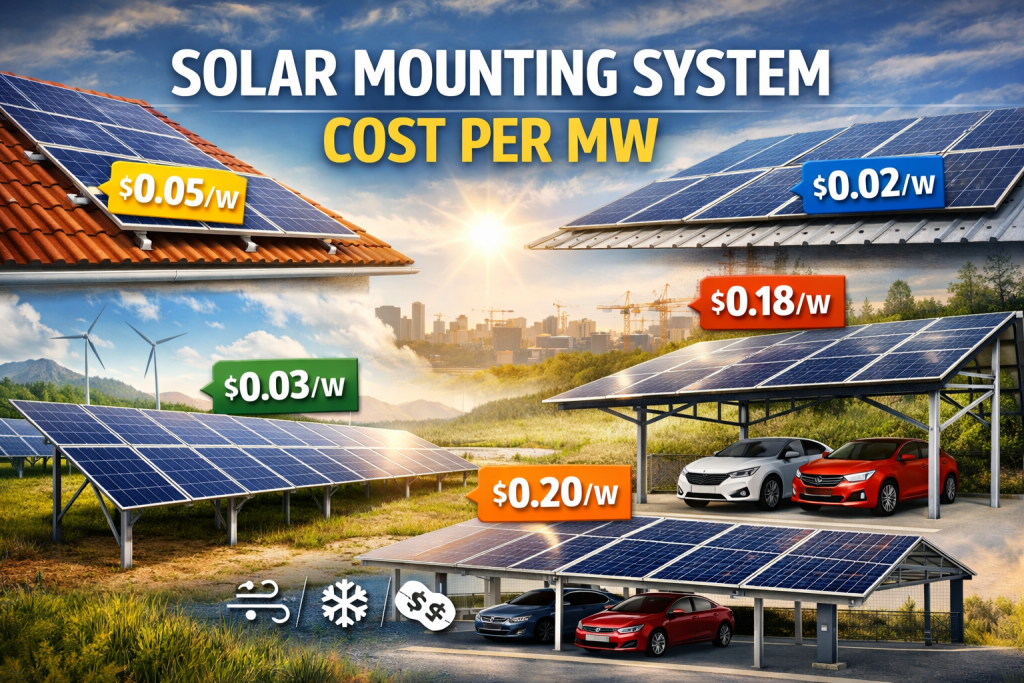
🏠 Tile Roof System
- Cost: ~$0.05/W
Tile roof mounting systems require careful hook design and waterproof considerations, especially for residential and light commercial buildings.
🏭 Metal Roof System
- Cost: ~$0.02/W
Metal roof systems are typically the most cost-efficient rooftop solution due to fast installation and minimal penetration design (kliplok / trapezoidal clamps).
🧱 Concrete Flat Roof System
- Cost: ~$0.06/W
Ballasted or anchored solutions are commonly used. Additional structure weight analysis and wind load resistance design increase material usage.
🌍 Ground Mount System
- Cost: ~$0.03/W
Standard ground-mounted systems offer the best balance of cost and scalability. Structure design varies depending on soil condition and terrain.
🚗 Aluminium Carport System
- Cost: ~$0.18/W
Aluminium carports are widely used in commercial parking lots and EV charging stations. Higher cost comes from structural aluminum profiles and architectural requirements.
🚗 Hot-Dip Galvanized Steel Carport
- Cost: ~$0.20/W
More robust and heavier-duty than aluminum systems, suitable for high wind or coastal environments. Steel usage and anti-corrosion treatment increase cost.
2. Why These Prices Are Not Fixed
It is important to understand that solar mounting system pricing is not a fixed number. The values above can change significantly depending on project conditions.
Key influencing factors:
🌬 Wind Speed & Snow Load
Higher wind zones or heavy snow regions require:
- Stronger profiles
- Thicker steel or aluminum
- More anchoring points
➡️ This directly increases material cost per watt
📐 Tilt Angle & System Layout
Different designs affect cost:
- Higher tilt angles → more steel consumption
- Complex layouts → more connectors and labor
- East-west systems vs south-facing systems
🧱 Ground Conditions / Roof Structure
- Weak soil → longer piles or concrete foundation
- Roof limitations → lighter or customized systems
📦 Raw Material Prices
Key materials affecting cost:
- Aluminum ingots
- Hot-dip galvanized steel
- Stainless steel fasteners
When raw material prices fluctuate, mounting system costs also adjust accordingly.
💱 Exchange Rate Impact
Since most systems are exported globally, exchange rates (USD vs RMB, EUR, etc.) can significantly affect final pricing.
3. Engineering vs Budget Pricing
In early-stage project planning, per-watt pricing is useful for:
- Feasibility studies
- Budget estimation
- EPC financial modeling
However, for final quotation, a proper engineering design is required, including:
- Structural calculation report
- Wind/snow load analysis
- BOM optimization
- Installation method review
Only after these steps can we confirm the accurate final cost per MW.
4. Conclusion
Solar mounting system costs typically range from:
- $0.02/W to $0.06/W for standard rooftop and ground systems
- $0.18/W to $0.20/W for carport structures
But the real cost depends heavily on engineering conditions, material selection, and market factors.
👉 The most accurate pricing always comes after a full project design review.